

When overseas buyers browse Lenovo’s international website, or watch tablet-related content on YouTube, they often notice the same thing:
Most Lenovo tablets shown in these channels carry model names that start with the letter “M.”
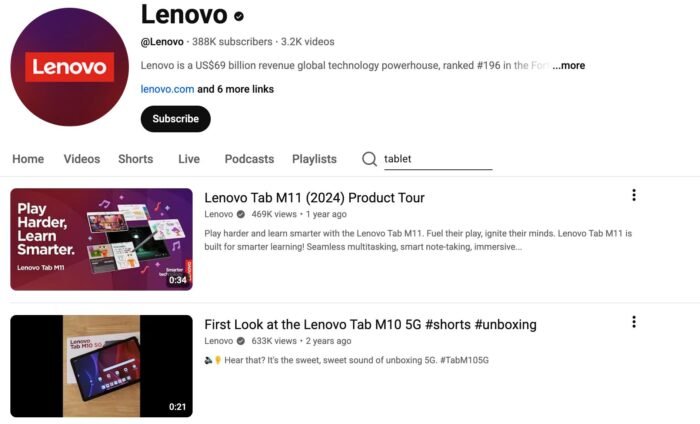
Models such as M9, M10, or M11 appear far more frequently than any other Lenovo tablet series. From an overseas perspective, this naturally creates an impression that the M series represents Lenovo’s mainstream or even “standard” tablet lineup.
At the same time, some overseas distributors tell us they occasionally encounter Lenovo tablets labeled P or K, such as P10 or K10, usually through alternative sourcing channels or supplier discussions. What adds to the confusion is that these tablets often look very similar in industrial design. The letter at the beginning changes, but the number remains the same.
This leads to a very common and reasonable question from overseas buyers:
If M10, P10, and K10 share the same generation number and similar appearance, are they actually the same tablet?
How Lenovo separates its tablet product lines by market
From our position as a Lenovo domestic distributor in China, the answer is clear:
M, P, and K are not different names for the same product. They are separate product lines designed for different markets.
The M series is Lenovo’s primary tablet lineup for overseas markets. These models are the ones Lenovo actively promotes on its global website and international marketing channels. The product strategy behind the M series is closely tied to overseas distribution realities. Pricing, channel competitiveness, and ease of market entry are all key considerations when these models are defined.
By contrast, the P series and K series are product line designations mainly used in China’s domestic market. The competitive environment in China is very different. Domestic buyers compare specifications in detail, and competition at the same price point is intense. As a result, tablets sold under P and K series designations often face higher performance and configuration expectations.
What overseas buyers may not always see is that these letters represent market strategy, not product hierarchy. A tablet labeled for the China domestic market is designed under a different set of competitive pressures than one labeled for overseas distribution.
Why the same generation number does not mean the same product
Another common misunderstanding comes from the numbers themselves. Model numbers such as 9, 10, or 11 indicate product generations, not screen sizes or identical hardware platforms.
Sharing the same generation number does not mean that M10, P10, and K10 use the same internal configuration. From our experience on the domestic side, the generation number mainly signals a rough product timeline, while key specifications are still adjusted according to the target market.
This means that even within the same generation:
- processors may differ,
- memory and storage configurations may not match,
- and overall performance levels can vary.
As a result, although M10, P10, and K10 may appear similar at first glance and belong to the same generation, they are not the same tablet. Their specifications reflect the market they were designed for.
For overseas distributors, understanding this distinction is critical. Relying only on model names or generation numbers can easily lead to incorrect assumptions during the sourcing process.
Where the real differences are: M10 vs K10 in actual specifications
From an overseas buyer’s point of view, Lenovo M10 and K10 tablets often look very similar. Their industrial design, branding, and even model numbers suggest that they belong to the same product family.
However, when we look at the actual specifications from the domestic side, the differences become clear. Under the same generation number, the M10 series is generally configured more conservatively than the K10 series, which is sold in the China domestic market.
These differences are not cosmetic. They directly affect performance, user experience, and product positioning. To make this clearer, we can compare a typical M10 model with its domestic counterpart, the Zhaoyang K10, side by side.
| Feature | Lenovo M10 | Lenovo K10 |
|---|---|---|
| Target Market | Overseas market | Chinese domestic market |
| Screen Size | 10.1 inches | 10.95 inches |
| Resolution | 800 × 1280 | 1200 × 1920 |
| Processor (CPU) | MediaTek MT6762 Helio P22T (12nm) | MediaTek Helio G88 (12nm) |
| Overall Performance | Basic | Better performance |
| RAM & ROM | 2GB RAM + 32GB ROM | Starts from 4GB RAM + 64GB ROM |
| Battery | 5000mAh | 7040mAh, fast charging |
This comparison reflects a pattern we frequently see across Lenovo tablet generations:
the overseas M series focuses on baseline usability, while the domestic K series is built with higher hardware expectations in mind.
Why the overseas M series is configured more conservatively
A natural question from overseas buyers is:
Why would Lenovo offer lower specifications for international markets?
From our experience working within the China domestic distribution system, the answer lies primarily in procurement behavior and channel expectations.
In many overseas markets, distributors and retailers are extremely price-sensitive. Purchase decisions are often driven by entry price rather than maximum configuration. As a result, tablets designed for overseas channels are optimized to:
- hit lower wholesale price points,
- reduce inventory risk for distributors,
- and remain competitive against similarly priced alternatives.
Because of this, products like the M10 are defined early on with cost control as a key objective. Hardware choices—such as processor, memory, storage, display resolution, and even battery capacity—are all influenced by the need to keep pricing attractive for overseas procurement.
This does not mean the M series is a “bad” product. It means it is a product designed around overseas channel economics, not around maximum hardware value.
Why domestic models like K10 often offer better value in hardware
The situation in China’s domestic market is very different.
Domestic buyers compare specifications in detail. Tablets with the same generation number compete fiercely on performance, memory, storage, and display quality. If a product is underconfigured, it quickly loses competitiveness.
Because of this environment, domestic models such as the K10 are pushed to offer:
- larger and higher-resolution displays,
- stronger processors,
- higher starting RAM and ROM configurations,
- and better battery performance.
From a hardware value perspective, this often results in domestic models offering noticeably stronger specifications than their overseas counterparts, even when the generation number appears the same.
For overseas distributors, this is an important insight. The M series represents what is officially promoted abroad, but it is not necessarily the best hardware Lenovo produces within the same generation.
What this means for overseas buyers and distributors
For overseas buyers, the key issue is not whether the M series is usable, but whether it truly represents the best available option within the same generation.
When sourcing Lenovo tablets through official overseas channels, buyers are usually exposed almost exclusively to M-series models. This creates a limited reference framework. Decisions are often made based on:
- model names,
- generation numbers,
- and surface-level specifications.
What is often overlooked is that the same generation may include domestic-market models with significantly stronger hardware, such as the K series. These options are simply not visible in Lenovo’s overseas-facing marketing ecosystem.
As a result, many overseas distributors end up purchasing tablets that are:
- sufficient for basic use,
- competitively priced,
- but not optimized for performance-driven or value-driven markets.
For distributors serving customers who care about screen quality, smooth performance, multitasking capability, or longer battery life, this gap can become a competitive disadvantage over time.
Understanding how Lenovo differentiates its domestic and overseas product lines allows buyers to reassess whether the default M-series choice truly aligns with their local market needs.
Our role: helping overseas distributors access better domestic-market options
As a Lenovo domestic distributor in China, we can ship the tablets that are designed for the China domestic market, including K-series models that offer stronger configurations within the same generation. This gives us visibility into product options that are rarely promoted outside China.
For overseas partners, this means the opportunity to:
- differentiate from competitors who only sell standard M-series models,
- offer better hardware value to end users,
- and align product performance more closely with local market expectations.
Rather than being limited to what is officially marketed overseas, distributors can make inquiries based on actual hardware differences, not just model labels.
Model names like M10, P10, or K10 may look similar, but the letter reflects the market strategy behind the product. Overseas M-series tablets prioritize pricing and channel needs, while domestic K-series and Zhaoyang K-series models offer stronger hardware. For distributors, the key is to focus on market logic and real specifications, not just the generation number or appearance, to make sourcing decisions that truly fit your customers’ needs.
